
Your Browser is not Supported
To use aviary, please update your browser to the latest version
Download Supported Browser
or
I understand the consequences
Go to Homepage
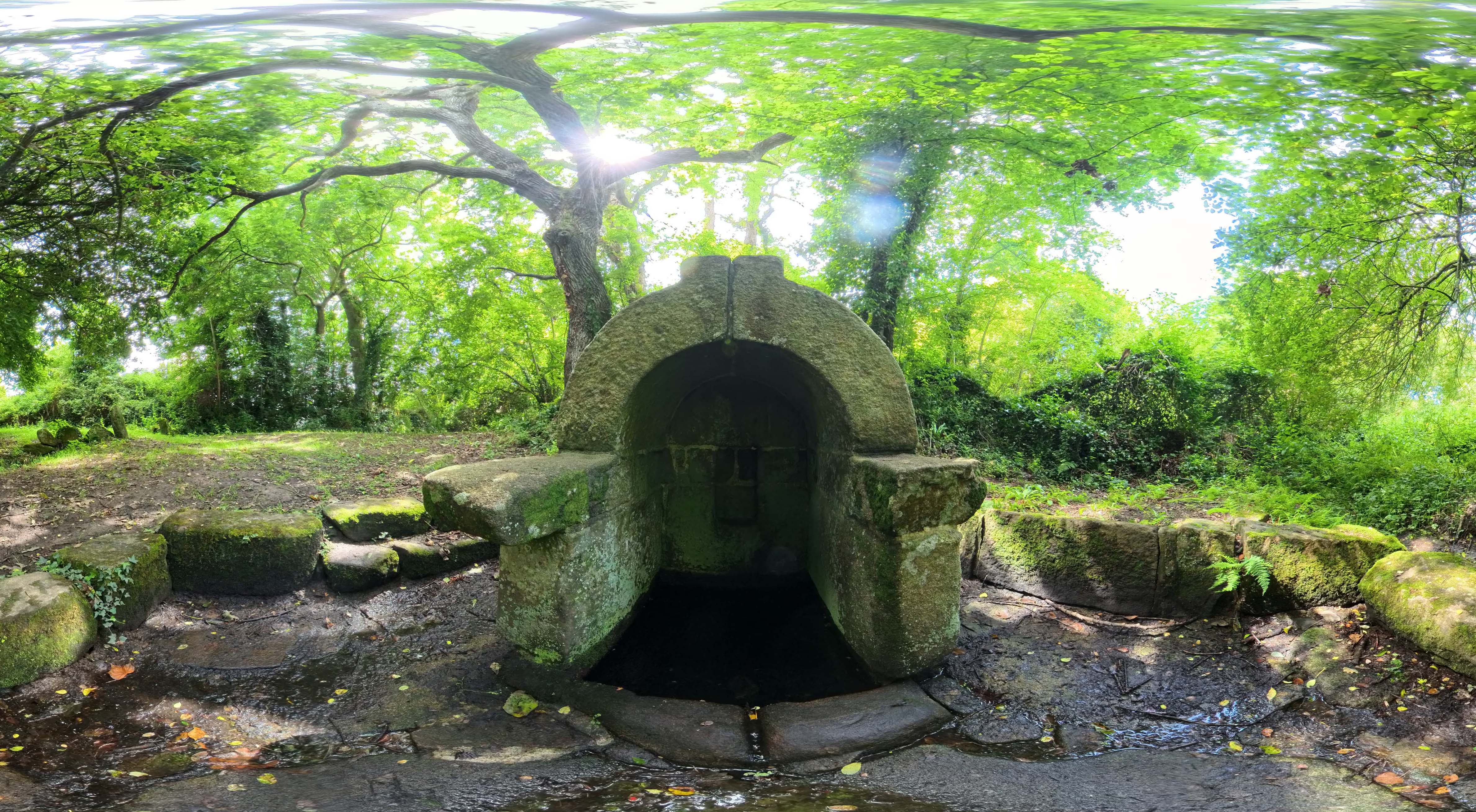
This is an open access repository of data from and about ancient Celtic healing fountains in Brittany, France gathered by Marilène Oliver and Scott Smallwood for the research creation project Fountains of Data. Many of the fountains, which date as far back as 5000 BC, were built upon in the 6th and 7th centuries by Welsh and Irish Catholic monks escaping the Anglo Saxon invasion. Elements of the ancient pagan rituals survived or were blended with Christian beliefs and persist today. In 2024, Oliver visited over 60 healing fountains, accumulating a considerable database of LiDAR scans, 360º videos and sound recordings, as well as knowledge about the specific fountains and their associated rituals. La Fontaine Saint Goulven near Kerlouen, for instance, which has a Renaissance-style architecture, includes a sarcophagus in one wall where Saint Goulven once slept, and now the sick lie in the hope of being healed. Once a year, the local priest brings a relic of Saint Goulven (an arm bone) and dips it in the water to renew the water’s curative properties. The fountains in the database are in the order in which Oliver visited the fountains.
The fountains are typically hidden deep in the Breton countryside and semi-overgrown; wildflowers grow and water trickles through the cracking stones, whilst songbirds chorus. These fountain ruins have a seductive beauty and romanticism that make us long for simpler times, less entangled with technology. As seductive as they may be, there are profane, public health reasons for the existence of these fountains: family doctors only arrived in the villages of Brittany in 1918, and even then visits could cost 10 days’ salary. For many Bretons living in rural poverty, fountains may well have been their only hope of being cured of an illness. Not that a visit to a healing fountain came without a cost: for the power of the waters to work a financial offering was required and it is from the accumulation of those offerings that neighbouring chapels were built. Although far from Alberta, through the final fountain in the collection, Fontaine Saint Anne D’Auray, we find a direct colonial link to the healing waters at Lac Saint Anne, which is 75km northwest of Edmonton. First called Wakamne (or “God’s Lake”) by the Alexis Nakota Sioux Nation who live on the west end of the Lake and Manito Sahkahigan (or “Spirit Lake”) by the Cree, the lake was named “Lac Ste Anne” by Rev. Jean-Baptiste Thibault, the first Catholic priest to establish a mission on the site in 1842. In 1889, Father Lestanc organized the first annual pilgrimage to Lac Ste Anne in July, after he visited the St. Anne d’Auray fountain in Brittany the previous year and according to the Encyclopedia of French Cultural Heritage in North America, had a vision of Saint Anne who told him “not to abandon the mission in Western Canada, but to return there to restore veneration to her and to establish a sanctuary for her.”
This open access repository is part of a larger research-creation project that seeks to expose and make visible the evolving architectures and systems of healing in the digital age. Traditional sources of healing, such as the ancient water fountains in Brittany and lakes on Cree and Métis lands, have long been revered across cultures for their purported curative properties. As digital technologies increasingly shape our experience of health and well-being, new virtual and automated forms of healing and self-care are emerging in the form of AI powered apps and social media communities. Fountains of Data will creatively compare and contrast spaces of ancient and contemporary healing through the creation of multimedia installations, virtual reality artworks, sculptures and prints.
A note about Resource Order: The order for resources found within each individual fountain will include 360 video formatted in 4k (untitled), video formatted in 4k (untitled), full resolution 360 video formatted in 8k (titled), full resolution video formatted in 8k, and audio recordings (also titled). If resources include Images (either 360 images or not), these will be included in that fountain's Supplemental Files (found in the Supplemental Files tab of the right-hand column). 3D LiDAR scans are linked under the Relation section for each fountain or can be found here.

To use aviary, please update your browser to the latest version
I understand the consequences
Go to Homepage