
Your Browser is not Supported
To use aviary, please update your browser to the latest version
Download Supported Browser
or
I understand the consequences
Go to Homepage
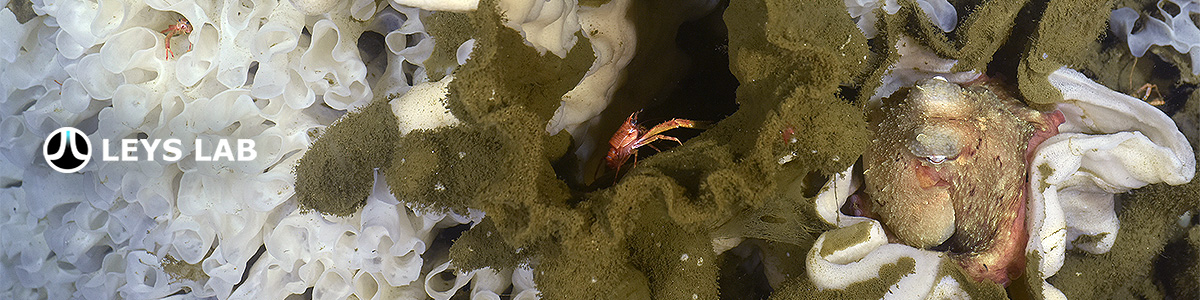
Hecate Straight Sponge Reef Dives
This is a collection of dive footage taken at the Hecate Strait Queen Charlotte Sound glass sponge reefs from trips made in 2015 and 2017 to investigate the diversity of the reef ecosystems and their vulnerability to sediments. The trips were funded by the Canadian Healthy Oceans Network (CHONe, NSERC), and Fisheries and Oceans Canada and took place on the Canadian Coast Guard Ship (CCGS) JP Tully, using the Canadian Scientific Submersible Facility remotely operated vehicle, ROPOS.
Overview:
Once a flourishing reef type in the Jurassic Tethys Sea, these extraordinary ecosystems are now reduced to just a few recently formed (9000 years ago) locations off the coast of British Columbia (Conway et al 2001). Like the more familiar coral reefs, these sponges form rich habitats for many other organisms including a variety of fish, crustaceans, and other invertebrates.
Why are they called “glass sponges”?
Sponges produce skeletons from two materials, either calcium carbonate (like coral) or silica (glass) (Leys 2013). Sponge skeletons are called spicules. While ~95% of sponges use silica this is usually produced as minute discrete delicate spicules with a multitude of shapes. Glass sponges, however, produce both discrete spicules and can also fuse those together to construct three dimensional scaffolds creating a translucent framework for their soft tissue to grow on.
How do sponge reefs form?
When glass sponges die their rigid skeletons do not dissolve and instead provide a rugged base for new sponges to settle and grow on (Leys 2013). The framework creates an elaborate habitat for a diversity of fish and invertebrates, making them excellent reef builders. There are 3 main species responsible for building the reefs: Heterochone calyx, Aphrocallistes vastus, and Farrea occa (Conway et al 2001).
Why is conserving these reefs important?
Glass sponges take a long time to grow with an average growth rate of about 2 cm per year (Leys 2013). With some sponges reaching 1.5 m tall and an estimated age of over 200 years, any damage done to the reefs will take an extraordinarily long time to reverse. Additionally, sponges that encounter sediment in the water column will arrest their feeding for up to 6 hours after the water clears, slowing growth rates further (Grant et al 2019).
The reefs were first discovered in 1988 through geological surveys done in the area, however the first direct human observation of the reefs was made in 1999 (Conway et al 2001). By the time they were discovered extensive damage had already occurred through trawling done by fishing vessels in the area. In 2001 a voluntary pause on fishing in the region was put in place with trawling there being banned in 2002, however it wasn’t until 2017 that the reefs were officially designated a Marine Protected Area (Fisheries and Oceans Canada 2019).
The current dimensions of the conservation area are designed to minimize the amount of sediment produced through anthropogenic activities from reaching the reefs. This includes a fixed central core protection area which surrounds the immediate area taken up by the reefs, and an adaptive management zone around that based on the travel distance of suspended sediments in the water column.
For more information visit: glassspongereefs.com
References:
Conway, K. W., Krautter, M., Barrie, J. V., & Neuweiler, M. (2001, June). Hexactinellid Sponge Reefs on the Canadian Continental Shelf: A Unique "Living Fossil". Geoscience Canada, 28(2), 71-78.
CPAWS-BC. Retrieved from Glass Sponge Reefs: glassspongereefs.com
Fisheries and Oceans Canada. (2019, September 18). Hecate Strait/Queen Charlotte Sound Glass Sponge Reefs Marine Protected Area (HS/QCS MPA). Retrieved from Fisheries and Oceans Canada: https://www.dfo-mpo.gc.ca/oceans/mpa-zpm/hecate-charlotte/index-eng.html
Grant, N., Matveev, E., Kahn, A. S., Archer, S. K., Dunham, A., Bannister, R. J.-M., & Leys, S. P. (2019, April 18). Effect of suspended sediments on the pumping rates of three species of glass sponge in situ. Marine Ecology Progress Series, 615, 79-100.
Leys, S. P. (2013). Effects of Sediment on Glass Sponges (Porifera, Hexactinellida) and projected effects on Glass Sponge Reefs. Ottawa: Fisheries and Oceans Canada.

To use aviary, please update your browser to the latest version
I understand the consequences
Go to Homepage